
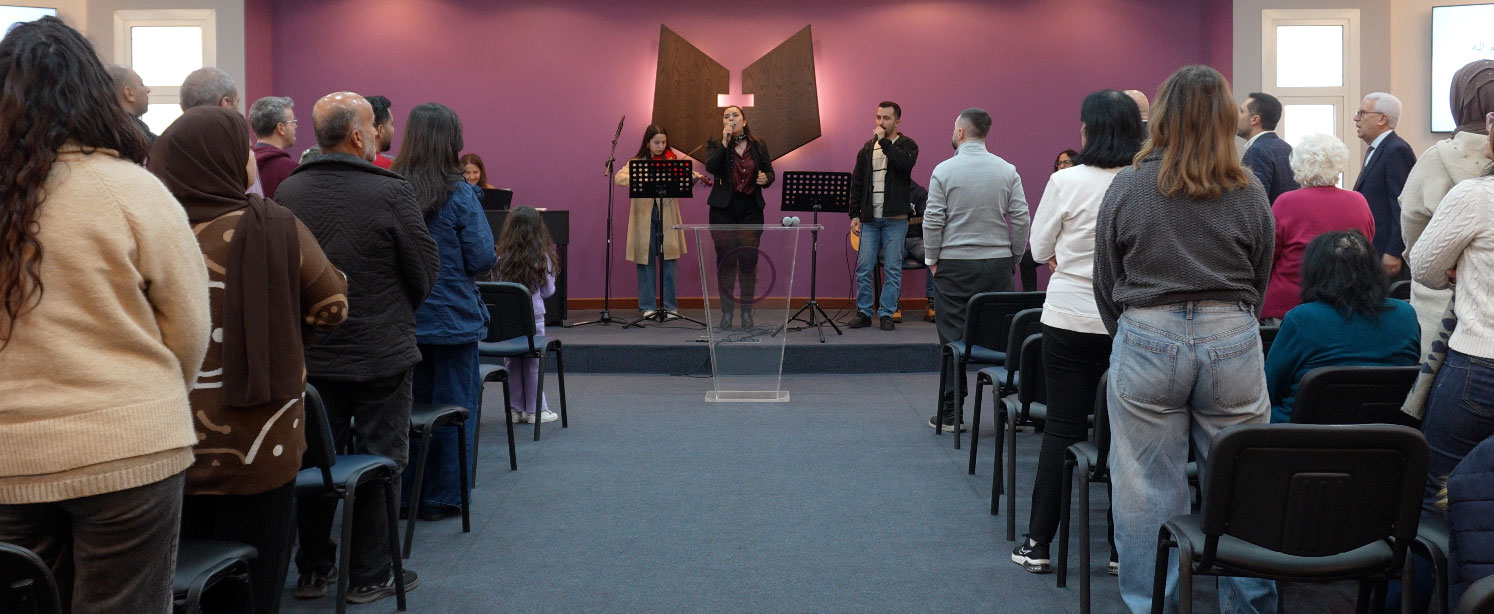
God Our Refuge
Pslam 46
By Wissam Nasrallah
We live in a world where refuge has become one of the most precious words a human being can hear, especially in Lebanon.
Once again, Lebanon finds itself in a war it did not choose, facing widespread displacement. Once again, the roads are filled with families carrying what they can and leaving behind what they love. More than 20 percent of the population has already been displaced: people uprooted, villages emptied, livelihoods crushed, and a nation already exhausted being asked to endure yet again. Behind every number is a name, a child, a mother, a grandfather, a home now silent.
That is why Psalm 46 speaks so powerfully into times like these. It does not offer shallow comfort. It gives us language for collapsing worlds: “God is our refuge and strength, an ever-present help in trouble” (Ps. 46:1). Notice: it does not first say that God gives refuge, but that God is our refuge. He does not merely send help from a distance. He gives us Himself.
Psalm 46 is striking because it is so realistic. It does not deny trouble or minimize suffering. It speaks of the earth giving way, mountains falling, and waters roaring. And yet our hope is anchored in the sovereign God who rules over nations, governs history, and remains present with His people in the midst of turmoil.
Psalm 46 is not sentimental theology. It is wartime theology. It reminds us that when everything visible feels unstable, the throne of God remains unshaken.
This is why the psalm can say, “Therefore we will not fear.” Notice what it does not say. It does not say, “Therefore we will understand everything.” It does not say, “Therefore we will control outcomes.” It says, “Therefore we will not fear.” Why? Because the absence of fear is not based on the absence of trouble, but on the presence of God.
Refuge is not ultimately found in circumstances that finally cooperate. Refuge is found in the God who remains faithful when circumstances do not.
That is the great reordering of faith: not that pain is unreal, but that pain is not ultimate; not that danger disappears, but that danger does not have the final word; not that the people of God are spared all suffering, but that they are never abandoned within it.
And this is where the gospel brings Psalm 46 into even sharper focus. For Christians, refuge is not an abstract idea. It is a person: Jesus Christ. He entered our unstable world and bore the ultimate storm of divine judgment so that all who are in Him might find eternal shelter in the mercy of God.
This means that for the believer, refuge is not merely emotional consolation. It is covenantal security. It is the settled reality that in Christ we belong to God, are loved by God, and can never be separated from the love of God.
But Psalm 46 does more than comfort us. It also commissions us. When God becomes our refuge, we become a people of refuge for others. Those who have been sheltered by God are called to embody His compassion in the world and to shelter others in His name.
So as we intercede for Lebanon, we pray that war will not have the last word, that fear will not silence hope, and that Christ will be known as Lord over Lebanon over its villages and cities, over the displaced and the grieving, over the exhausted and the forgotten.
I want to end where the psalm ends: “Be still, and know that I am God.”
Be still, not because the crisis is small, but because God is great. Not because history is manageable, but because history is His. Not because Lebanon’s pain is light, but because the Lord remains mighty, present, and full of compassion.
And He is with us.
Amen.